
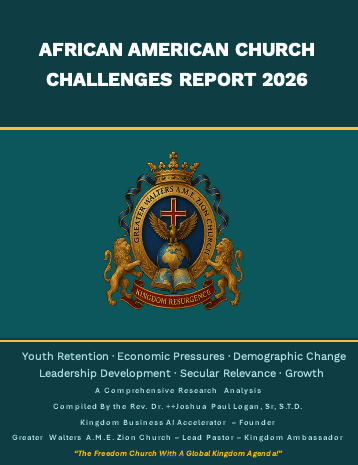
African American Church Growth Challenges Report 2026

African-American-Church-Growth-Challenges-Report-2026-Joshua-Paul-Logan
African American Church Challenges & Solutions Report
Research Report · 2020–2026

The African American Church
Challenges & Solutions
Report

A landmark 22-page study drawing on Pew Research, the Hartford Institute EPIC Study, and 30+ sources — revealing the urgent forces reshaping Black churches and the proven strategies driving revival.

33% Millennial Unaffiliation
−20pt Membership Drop (2 decades)
34% Churches: Worsened Finances
66% Leaders Receive No Support
22 pgs Free Research Report

The Black Church is at a historic crossroads.

For generations, African American churches have been the spiritual backbone, economic engine, and cultural anchor of their communities. But a convergence of generational disaffiliation, financial pressure, leadership gaps, and cultural shifts is testing that foundation like never before.

This report doesn’t just document the crisis — it maps the path forward.

  • Generational unaffiliation data broken down by Silent Gen through Gen Z
  • Financial sustainability metrics compared across Black, White, and multiracial congregations
  • Leadership succession crisis data — and why 66% of trained leaders receive zero compensation
  • Case studies from Transformation Church, New Birth Missionary Baptist, and Empowerment Temple
  • Five evidence-based strategic recommendations for revival and growth

What the data reveals about the struggle ahead

Each chapter in the report tackles one challenge with hard numbers, root-cause analysis, and real congregation examples.

33% / 28%

Youth Retention & Generational Disaffiliation

One-third of Millennials and 28% of Gen Z identify as religiously unaffiliated. Among those who do affiliate, attendance at Black churches drops sharply with each generation — from 67% among Boomers to just 50% among Millennials and Gen Z.

Critical Severity
−20 pts

Membership Trends & Demographic Shifts

Gallup data shows Black adult church membership has dropped approximately 20 percentage points over two decades. Gentrification has displaced over 261,000 Black residents from 523 neighborhoods — forcing church closures and sales across urban cores.

High Severity
34%

Economic Pressures & Financial Sustainability

Hartford Institute data (2024) shows 34% of Black churches reported worsened finances between 2018 and 2023 — compared to 29% of white churches. With 32% of Black attenders in congregations of 50 or fewer, the financial base is dangerously thin.

High Severity
66%

Leadership Development & Succession Planning

USC’s Passing the Mantle study found 66% of trained Black church leaders receive no financial support from their home congregations. A 15% increase in clergy considering leaving ministry was recorded between 2021 and 2023. The succession pipeline is broken.

Critical Severity
47%

Relevance in Secular Society

47% of Americans say churches are less influential than they were 50 years ago. As secularism expands and digital culture redefines community, Black churches face the urgent question: how do you remain prophetically relevant without compromising spiritual identity?

Moderate–High Severity

“The crisis is real — but so is the resilience. Congregations that adapted fastest saw 10× growth. This report shows exactly what they did differently.”

— African American Church Challenges & Solutions Report, 2026
Young African Americans gathered in a church fellowship hall for a youth group meeting

Winning Back the Next Generation

The data is sobering. But it’s not destiny. The report profiles churches that reversed youth disaffiliation through bold programming, authentic community, and intergenerational mentorship.

49%
of Black Millennials rarely or never attend church — but want something meaningful (Pew Research, 2021)

The report identifies the exact inflection points where young Black adults disengage — and the specific church strategies that re-engage them before they’re lost entirely.

The Leadership Crisis No One Is Talking About

Across the Black church landscape, pastoral leadership is aging, succession plans are absent in over 60% of small congregations, and the clergy considering leaving ministry has spiked 15% in just two years.

The report examines how congregations can build leadership pipelines that develop, compensate, and retain the next generation of Black church leaders — before the pews empty for good.

15%
increase in Black clergy considering leaving ministry — 2021 to 2023 (Hartford Institute EPIC Study)
Distinguished African American pastor seated at a desk in his church office, surrounded by theological books
Professional research report on mahogany desk with reading glasses and fountain pen

22 Pages of Research, Insight & Strategy

  1. Youth Retention & Generational Disaffiliation — unaffiliation rates by generation, attendance patterns, engagement triggers
  2. Membership Trends & Demographic Shifts — Gallup 20-year data, gentrification displacement, congregation size distribution
  3. Economic Pressures & Financial Sustainability — income metrics, COVID impact by race, property & housing strategies
  4. Leadership Development & Succession — pipeline gaps, compensation crisis, seminary contraction, succession frameworks
  5. Relevance in Secular Society — cultural influence decline, digital community, prophetic identity strategies
  6. Growth Case Studies — Transformation Church, New Birth Missionary Baptist, Empowerment Temple, cautionary tale of The Potter’s House
  7. Comparative Tables & 5 Strategic Recommendations — actionable roadmap for revival backed by data

Research drawn from 30+ verified sources including

What Thriving Churches Are Doing Differently

The report profiles congregations that didn’t just survive the challenges — they turned them into catalysts for explosive growth.

Strategy 01

Youth Voice Councils

Giving Gen Z and Millennials genuine decision-making authority — not token youth groups — creates ownership and dramatically reduces disaffiliation among 18-to-35-year-olds.

Strategy 02

Digital-First Community

Churches like Transformation Church grew from 350 to 250,000+ weekly online attendees by treating digital as a primary campus — not a secondary livestream.

Strategy 03

Property as Ministry

New Birth Missionary Baptist and Genesis Worship Center converted church property into affordable housing, generating revenue while serving the community and defeating gentrification.

Strategy 04

HBCU Leadership Pipelines

Formal partnerships with HBCUs and distance-learning theological programs rebuild the seminary pipeline and identify, develop, and fund the next generation of Black church leaders.

Strategy 05

Succession-First Governance

Congregations that build succession plans into their founding governance documents — not as an afterthought — avoid the catastrophic membership collapses seen at leader-dependent megachurches.

Growth Case Study

Transformation Church, Tulsa — Pastor Michael Todd

From a congregation of 350 members and a $1.6M budget in 2015, Transformation Church grew to 4,000+ in-person attendees, 250,000+ weekly online viewers, and a $22.5M operating budget by 2019 — then achieved 10× digital growth during COVID while most churches collapsed.

10×
COVID-era digital growth
$22.5M
Operating budget (2019)
$67M
Real estate portfolio
250K+
Weekly online attendees
Free Download · No Cost · Instant Access

Get the Full Report — Free

22 pages of research, comparison tables, case studies, and strategic recommendations — in one beautifully designed PDF, yours to keep and share.

Your information is never sold or shared. This is a Kingdom resource — freely given.

Kingdom Culture Business Lifestyle Consulting · Washington, D.C.

Research compiled from 30+ verified sources including Pew Research Center, Hartford Institute EPIC Study (2024), USC CRCC, Gallup, NCRC, and peer-reviewed dissertations. All data cited with full source attribution inside the report.

© 2026 JP Logan & Associates. All rights reserved. · jplogan.org